What legaltech companies are filing patents on
Six companies, their patent filings, and what we think the application histories tell us.
We were searching through patents for some legal-AI tasks we're building. We found filings on document questions, contract revisions, citation checks and model selection. So we looked at what six companies filed, what happened next, and where the claims changed.
A patent application is a request for protection. Publication doesn't mean it was granted. The claims are the numbered statements that define a granted patent's legal scope. Comparing the application's claims with the granted ones can tell you more than the title does. UK IPO publication guide; USPTO guide to claims
Harvey: document answers and source citations
Harvey filed US20250298816A1 in March 2024. It was published in September 2025 under Counsel AI Corporation, Harvey's former corporate name. The old name matters when you search for it. Corporate-name record
The application describes using language models to build document outlines, generate details such as the title, date or parties, and answer questions. Its first published claim also includes retrieving candidate source sentences and having a language model rank them as support for a sentence in the answer.
Google Patents lists a September 2025 non-final action, January 2026 final-rejection entries and a July 2026 ready-for-examination event. Google Patents displayed the application as pending when we checked on November 12. We couldn't retrieve the actual office actions, so that timeline doesn't tell us why it was rejected or what happened between those entries. A final-rejection label alone doesn't mean the application was abandoned.
We read the filing as an effort to protect the work around the answer: organizing the document, assigning model tasks and connecting answer sentences to evidence. The international publication discusses speed, context limits, accuracy and resource use. Those look like the engineering problems they were trying to solve.
Casetext: what happens after the model answers
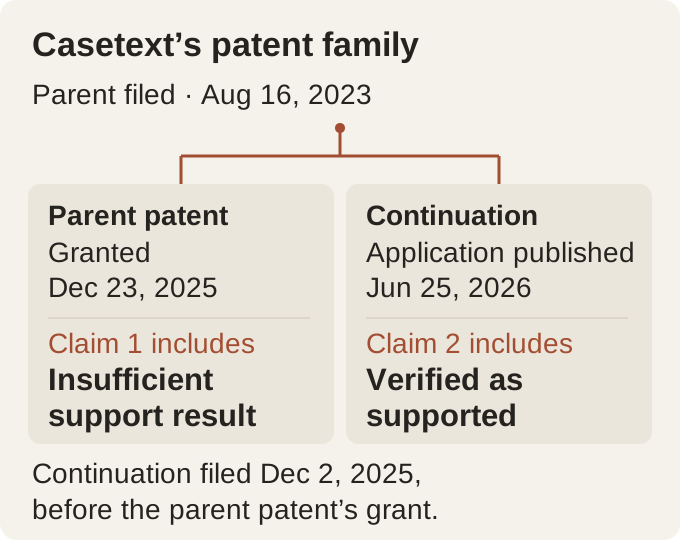
Casetext's US12505299B2 was granted in December 2025. Claim 1 assigns identifiers to source passages, generates text that cites them, and asks a language model whether the cited passages support a generated passage. The claim also includes receiving an insufficient-support result and using it to decide what message the user gets.
That verification sequence was already in the application published in February 2025. In claim 1, the grant adds “one or more” before the source text documents.
Casetext also filed a continuation on December 2, 2025, before the December 23 grant. A continuation is another application based on the earlier disclosure. It lets the applicant pursue another set of claims. USPTO continuation guidance
That continuation was published in June 2026. Its independent claim 2 includes verification that the generated passage is supported. Dependent claim 3 adds regeneration when support is insufficient. These are published application claims, not another grant.
Our read is that Casetext was trying to protect a workflow that connects cited source passages, verification and the response the user gets.
BlackBoiler: reuse the edits people already made
BlackBoiler filed US10489500B2 in January 2019 as a continuation of a 2016 application. It was granted in November 2019. The family claims priority to an August 2015 provisional filing.
The method matches new text with an original example that has a paired final version. It lines up the new text with the original, works out edits from the paired final text, and applies them to the new text according to that alignment.
The May 2019 publication already marks claims 1–27 as canceled. Its first live claim, 28, has the same operative steps as granted claim 1; the granted preamble drops the word “improving.” We can't treat that published version as the original claim set or reconstruct the whole examination from it.
To us, this looks like a way to make earlier editing decisions reusable. One reason: the next continuation, filed in November 2019 and granted in November 2020, discusses the loss of institutional knowledge when earlier edits are scattered among reviewers.
Icertis: the grant gets more specific
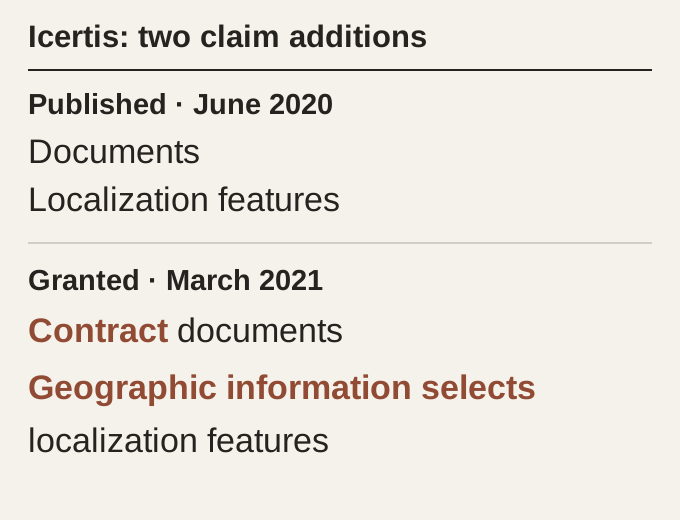
Icertis filed in December 2018. The application was published in June 2020, and US10936974B2 was granted in March 2021.
Both versions describe training candidate models, checking them against validation documents and ranking them before selection. Evaluators of wording and meaning, along with localization features, were already in the published claims.
The granted independent claims add contract-specific wording and require using geographic information to select localization features. Examples include languages, currencies, time zones, and currency and calendar formatting. We don't have the examiner's reasoning, so we don't know why those requirements were added.
In our view, the filing is aimed at how models are chosen for contract analysis. The granted claims include geography-specific handling. Calling it a patent on choosing an AI model would leave out requirements that are right there in the claims.
LegalOn: turn a revision policy into wording
LegalOn's Japanese patent JP7691604B2 describes getting a revision policy for a unit of legal text, using a prompt based on that text and policy, and producing revised text with a language-processing model.
The grant document records registration on June 4, 2025 and publication on June 12. Google's event index also lists a notification of reasons for refusal, a further amendment and a later grant decision. But claim 1 in the August 2024 international publication matches the Japanese grant's claim 1 in the original Japanese text we compared. Those event labels alone don't show that this claim was narrowed.
We think LegalOn was seeking protection for turning a revision policy into replacement language, through a prompt based on the policy and the text.
Power Law AI: feed review errors back into the process
CN120146296B names Beijing Power Law Intelligent Technology Co., Ltd., the company behind Power Law AI. The application was filed in March 2025 and published in June, with the grant published in October.
It describes reviewing contracts with a language model, retrieving earlier review errors, and generating correction suggestions. Information about the review logic, contract context, machine result and user feedback is stored together. Claim 1 includes updating the review logic when error feedback reaches a threshold.
The published application had ten claims, including a system claim. The grant has three method claims. In step S7 of claim 1, the application allowed adjusting the review logic or the review results; the grant retains adjustment of the review logic. We checked that difference against the Chinese texts, not just their English translations.
That suggests to us a feedback process that changes the review logic used for later contracts. That doesn't mean they were retraining model weights or doing reinforcement learning.
What the records tell us
The filings show what each company asked to protect, and the published claim versions let us see some changes. They don't tell us what shipped. Our interpretations above are about the apparent technical direction, not evidence of the companies' internal plans.
We used patent publications and publicly indexed events. We couldn't retrieve the office actions or applicant responses. Our summaries of the Japanese and Chinese patents use machine translations; we checked the specific claim comparisons against the original-language texts. This is a look at six patent families, not a complete patent landscape or an assessment of validity, infringement or current enforceability.