
Where Anthropic Got Its IPO Patents
Anthropic’s S-1 reports 40 issued U.S. patents and 26 foreign grants ahead of its IPO. Every single U.S. grant was acquired from IBM or Adept—while $477 million in individually priced startup acquisitions added zero.
Contents
In true LiTiL fashion, our plans to build legal tasks led us to some interesting discoveries. We started pulling AI patents for a task, which somehow led us to reading Anthropic’s IPO registration statement. On page 246 of Anthropic’s IPO registration statement, it told prospective public shareholders that as of September 30, 2026, it held 40 issued U.S. patents, 67 pending U.S. applications (including 32 nonprovisional and 35 provisional), 26 issued foreign patents, and 12 pending foreign applications.
Its intellectual property portfolio would give us a glimpse into what direction Anthropic may be going, and what they see as being important to their stack. We pulled the recorded deeds from the U.S. Patent and Trademark Office’s Assignment Center, matched them against prosecution histories and issued grants, and traced the corresponding international families across WIPO and seven foreign patent offices. By we, we mean we made Astra do it because we thought maybe seeing what Claude was doing would make it work harder (it did not).
Every one of Anthropic’s 40 issued U.S. patents came from an acquisition. Thirty-four originated at IBM across two off-market transfers—the first effective May 7, 2025 and the second signed September 4, 2026—and six originated in an April 2, 2025 portfolio purchase from Adept AI Labs. Thirty-three were already granted patents when Anthropic bought them and the remaining seven were pending applications.
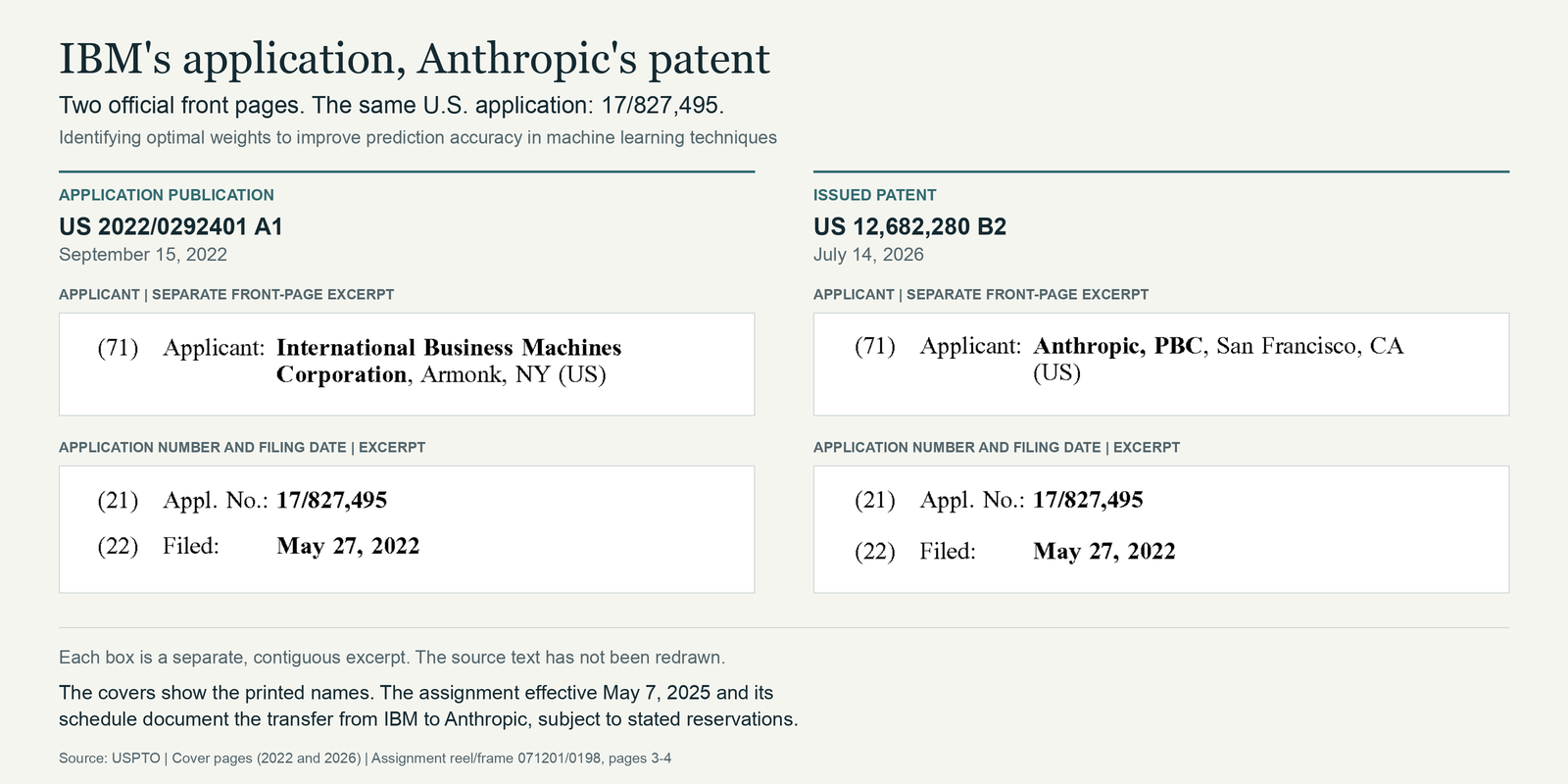
That paper trail explains both snapshots in Anthropic’s SEC filings. In its confidential June 2026 draft S-1, Anthropic reported 24 issued U.S. patents and 22 foreign grants as of December 31, 2025—matching IBM’s first 21 U.S. grants plus the first three Adept applications that issued in late 2025. Between January and September 2026, IBM’s second assignment added 12 issued U.S. patents, three more Adept applications issued, and one pending IBM application cleared appeal and issued in Anthropic’s name, bringing the U.S. ledger to exactly 40.
| Portfolio Segment | Originating Seller | Bought Issued | Bought Pending | Dec. 31, 2025 S-1 | Sept. 30, 2026 S-1 |
|---|---|---|---|---|---|
| U.S. Patents (Batch 1, May 2025) | IBM | 21 | 1 | 21 | 22 |
| U.S. Patents (Batch 2, Sept. 2026) | IBM | 12 | 0 | 0 | 12 |
| U.S. Patents (Agent Portfolio, Apr. 2025) | Adept AI Labs | 0 | 6 | 3 | 6 |
| Total U.S. Issued Patents | IBM & Adept | 33 | 7 | 24 | 40 |
| Foreign Issued Patents (S-1 Reported vs. Traced) | IBM Families (traced) | — | — | 22 (21 traced) | 26 (25 traced) |
Just as revealing is where Anthropic’s patents did not come from. In Note 15 of the S-1/A financial statements, Anthropic itemizes two major operating-company acquisitions: $171 million in December 2025 for Bun (Codeblog Corp., the high-speed JavaScript runtime acquired to power developer tooling behind Claude Code) and $306 million in May 2026 for Stainless (Stainless Software, Inc., which builds automated SDK and API-client generators). Alongside those deals, Anthropic acquired computer-use startup Vercept, Coefficient Bio, and Mithril Medicine. Across USPTO and international publication indexes, we found zero issued U.S. patents or published U.S. patent applications originating from any of those five acquired companies. Anthropic bought engineering teams and developer infrastructure through corporate M&A—and quietly bought its entire issued patent portfolio off the shelf from IBM and Adept.
Buying GUI-Agent Patents After Shipping Computer Use
Anthropic’s IPO pitch rests on moving beyond conversational chat into software that does real work on a computer. Throughout the prospectus, Anthropic highlights Claude Computer Use, Cowork (navigating desktop browsers and native apps), and Claude Managed Agents—crucial revenue engines when 79% of Anthropic’s nine-month 2026 revenue comes from usage-based token billing rather than flat subscriptions.
Interestingly enough, Anthropic’s six Adept-origin patents sit right on top of that agent workflow, though the dates show Anthropic did not buy Adept’s filings to invent Computer Use. In June 2024, Adept’s co-founders and core researchers left for Amazon, which took a non-exclusive license to Adept’s agent models and datasets. Four months later, in October 2024, Anthropic launched Claude’s Computer Use beta—the same month Adept filed eight U.S. agent patent applications on the USPTO’s fast-track examination schedule. By the time Anthropic bought that Adept docket effective April 2, 2025, examiners had already approved the claims in three of the eight cases. Because all six resulting patents issued after closing with Anthropic’s name on the cover, outside analysts like PatentVest mistook the first grant (U.S. 12,387,036) for a "homegrown" Anthropic invention, missing Adept’s October 2024 filing receipt and the April 2025 transfer deed.
Strip away the patent jargon, and the six Adept grants Anthropic now owns cover three practical pieces of building a computer-using agent: how it reads a screen, how it clicks and types, and how you generate the examples used to train it.
Two of the grants (U.S. 12,387,036 and U.S. 12,619,815, built on Adept’s Fuyu-8B architecture) cover how a model takes in a screenshot alongside a written prompt. Most multimodal systems run images through a separate vision model before handing them off to a language model. Under Anthropic’s acquired claims, the software instead slices a screenshot line by line into small image patches (converted into magnitude-invariant bit vectors in the 2026 grant), drops a newline marker between lines so the model keeps the 2D layout of the screen, mixes those image pieces into the same stream as the text tokens, and projects that single stream straight into a decoder-only transformer—bypassing a separate vision encoder or standard token-embedding lookup. We’re not sure what that means, but it sounds complicated so go team. Another of the pre-allowed grants (U.S. 12,430,150) covers how the agent actually operates an interface: software on the user’s device builds a workflow description for a server to translate into an intermediate plan, then queries the agent locally and converts its returned function into real clicks, keystrokes, or browser commands—the client-side sequence the examiner singled out in allowing all 20 claims.
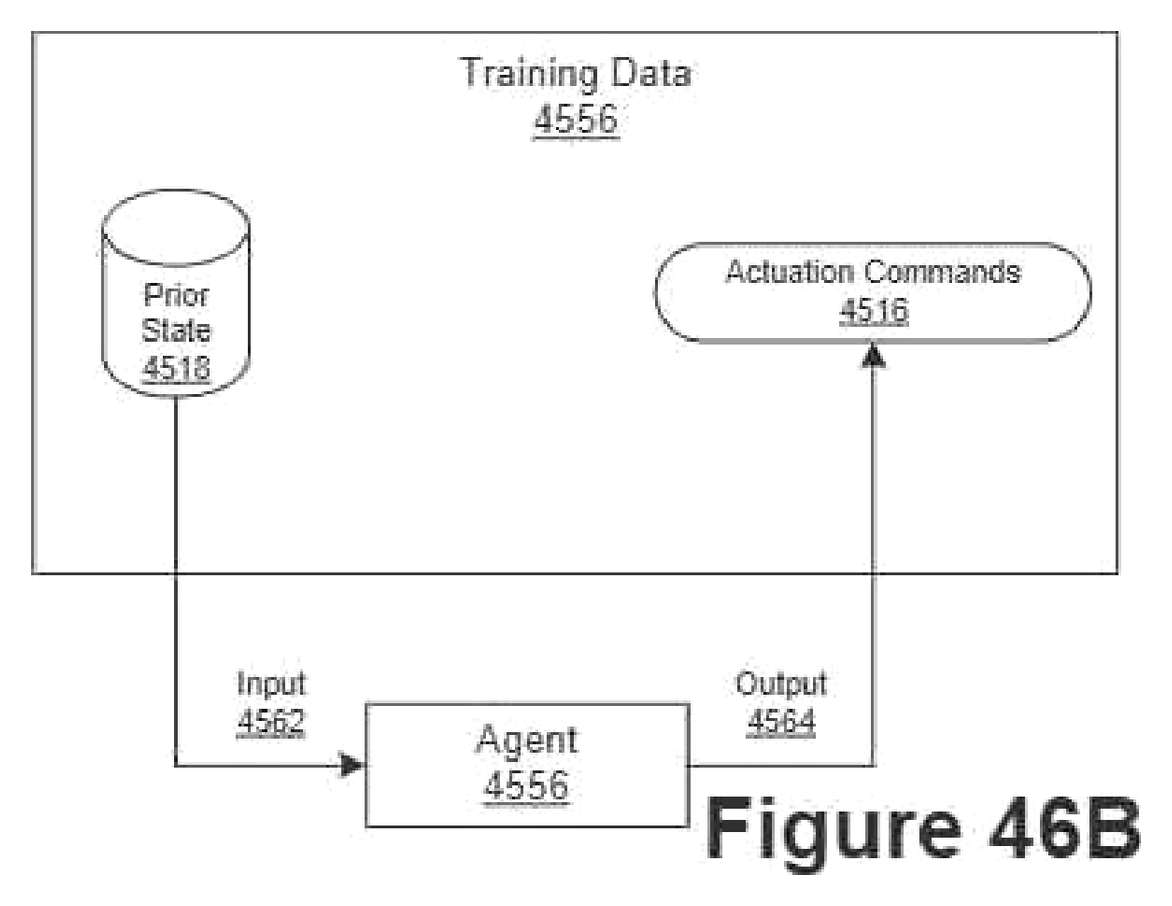
Two more grants (U.S. 12,437,238 and U.S. 12,585,862) cover how you create training data for those agents. Suppose you want to teach an AI agent to fill out an expense report or pull records from a database by watching a person do it first. Under 12,437,238—approved by the examiner five days before Anthropic closed the deal—software sits between the user and the interface, saves a snapshot of what the screen looked like before the task began, and records the user’s actions. After the examiner cited an earlier patent filing by Pierucci and colleagues, Adept narrowed Claim 1 to require a multimodal transformer running right on the user’s device to translate those recorded human actions into clean, replayable computer commands, pairing the "before" screen with the commands as a training example (shown in Figure 46B). Its companion grant, 12,585,862, claims training a vision-language agent on a specific eight-part data recipe—mixing documents with interleaved text and images, text embedded in images, software-usage videos, PDFs, tool-usage videos, open- and domain-specific web pages, and images of the agent’s own workflows—so it can read a screenshot, run one command, inspect the updated screen, and repeat until the task is finished. This one we actually understood and think is pretty cool.
A person enters a taxi fare in an expense report. Follow that one demonstration from a blank form to an example an agent can learn from.
Illustrative screen and commands. Claim 1 of U.S. patent 12,437,238
Figure 46B · The training pair
While Adept had already done the heavy lifting on the 2025 grants, Anthropic’s own legal strategy shows up clearly in the cases that were still contested after the purchase. When an examiner issued a May 2025 final rejection in application 18/909,068 over older macro-recording software, Anthropic’s lawyers rewrote Claim 1 to add a tighter execution loop on top of the starting screen and step-by-step subtasks: taking in both a plain-English workflow description and a prescriptive command, writing out actions in a custom command language that mixes model calls with localized web or app events, and feeding fresh screenshots and action histories back into the agent after each step. That narrowed patent issued to Anthropic in March 2026 as U.S. 12,566,913. And in still-pending application 18/909,531—where an examiner cited the academic WebLINX benchmark for web-browsing agents—Anthropic argued in September 2026 that predicting the next move in a static benchmark is fundamentally different from its claimed three-part setup, where one server trains the agent, a production server issues commands, and the user’s device executes them.
Post-Training and the S-1: Why Anthropic’s 34 IBM Patents Matter
To understand why Anthropic bought 34 patents from IBM—and why it fought to rescue one rejected IBM training application on appeal—you have to read what Anthropic tells IPO investors a few pages earlier in the prospectus about post-training.
On pages 196–197 and 239 of the S-1/A, Anthropic separates model building into two distinct phases. Pre-training—feeding vast amounts of text and code into a base model—creates raw language and reasoning ability. Post-training is everything done afterward, using reinforcement learning and supervised training, to turn that raw model into a practical worker that can write production code, use software tools, follow complex instructions, and act on a user’s behalf without going off the rails. Anthropic tells prospective shareholders that post-training "has evolved from a minor adjustment step into one of the largest areas of our research investment, reflecting the evolution in model capability from conversational assistants to autonomous agents that perform tasks independently."
More tellingly, Anthropic writes on page 239 that post-training centers on training Claude against "complete, realistic tasks whose complexity reflects the demands of real professional environments," calling that internal task library "one of our most durable scientific advantages, which we believe is difficult to observe from outside the organization and correspondingly difficult to replicate." Because filing a patent forces an inventor to publish the recipe, Anthropic keeps its own post-training tasks and alignment pipelines locked up as trade secrets, noting on page 246 that only a subset of its own staff can view its most critical intellectual property.
Yet when you read the 34 IBM patents Anthropic bought—against $18.81 billion in compute and infrastructure expenses in the first nine months of 2026—a clear theme emerges. While keeping its internal recipes secret, Anthropic quietly bought patents covering how models weight training examples, learn to call external tools, resist misleading prompts, fine-tune privately for enterprise customers, and trim inference costs.
The IBM Appeal Anthropic Inherited: Teaching One Model to Weight Another Model’s Training Data
The centerpiece of that effort is application 17/827,495, which Anthropic bought from IBM in May 2025 while it was on appeal at the Patent Trial and Appeal Board (PTAB) and which issued to Anthropic on July 14, 2026 as U.S. 12,682,280.
In plain English, the patent tackles a core headache in training and post-training: figuring out how much each training example should count. When you train a model on thousands of examples—coding problems, contracts, or user prompts—some examples teach vital patterns, while others are repetitive, noisy, or mislabeled. Classic machine-learning methods like "boosting" use a blunt rule: if the model gets an example wrong, turn up the weight on that example in the next round; if it gets it right, turn the weight down. That backfires whenever a dataset contains bad or noisy outliers, because forcing the model to study broken examples makes it memorize garbage and perform worse on new data.
The patent replaces that fixed rule with a reinforcement-learning approach it calls "learning to teach," pairing a student model (the AI actually learning the task) with a teacher model (a second AI whose only job is deciding how much weight to give each training example). First, a current student model trains on the dataset. Looking at how that current student is doing, the teacher assigns a new set of weights to the training examples, dialing some up and others down. Next, a challenger ("candidate") student trains on the same data using those new weights. The system tests both the current student and the challenger across the training data and held-out test data—examples with known right answers—to see which one predicts the real outcome more accurately. That test comparison produces a reward score that trains the teacher via reinforcement learning, teaching it which data weights actually build a smarter student.
A student model predicts how long a contract review will take. Its first prediction is the average of three past reviews. Try the same three examples with a different set of teacher weights.
Illustrative review times and student model. Claim 1 of U.S. patent 12,682,280
Figure 6 · The model and its weights
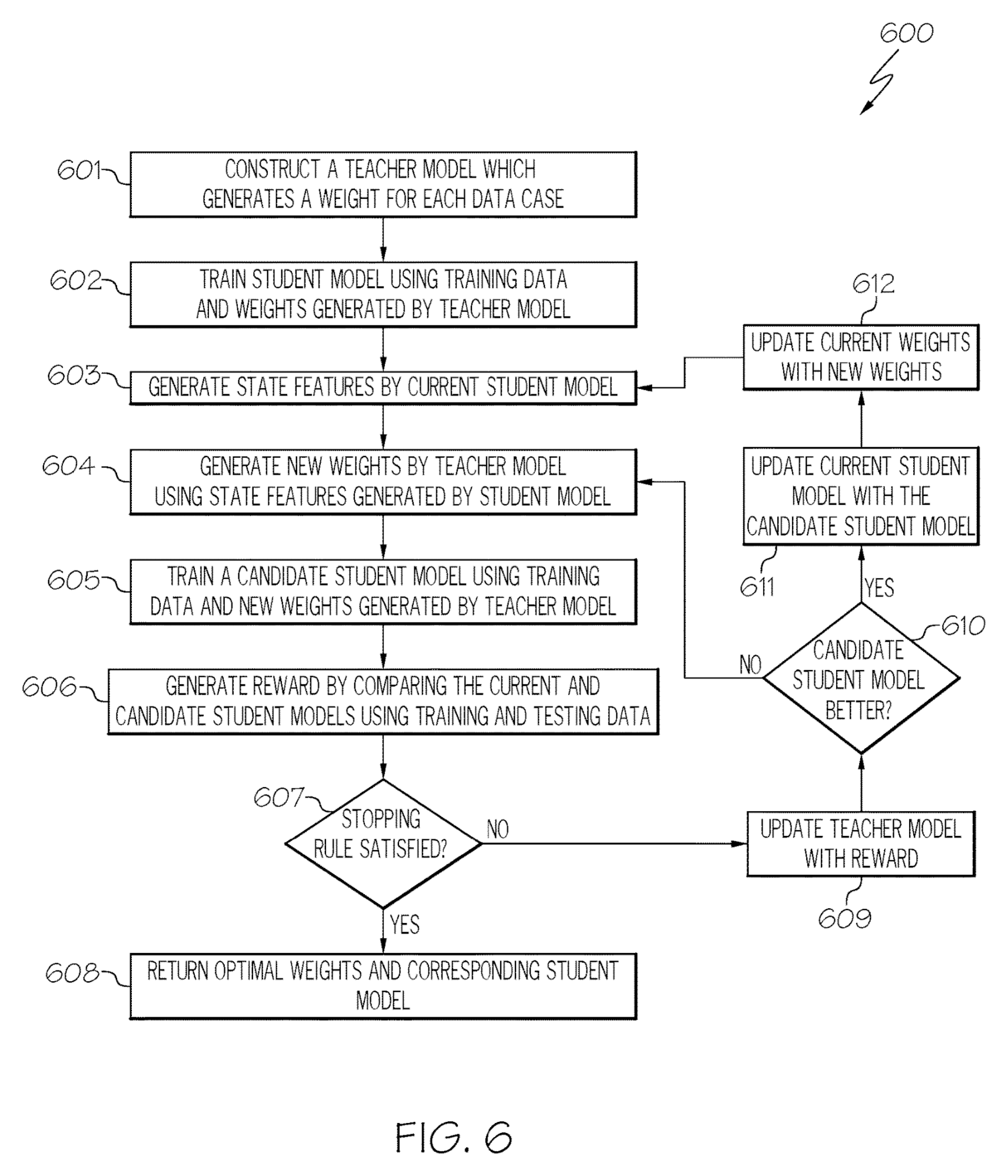
IBM had appealed the examiner’s obviousness rejection before selling the filing to Anthropic, and the PTAB issued its decision on December 30, 2025, seven months after Anthropic took over. The Board upheld the rejection of six claims—all three main (independent) claims plus three dependent claims—agreeing that two earlier publications already taught training a teacher-weighted challenger model and checking whether it beat the current model (through step 610 in Figure 6). What survived the appeal were three narrower dependent claims adding steps 611–612 on the right side of Figure 6: when the challenger beats the current student on the target test, the system replaces both the current student model and the active set of training weights with the winning pair. The examiner had not shown that earlier papers taught adopting both the winning model and its winning data weights together.
In February 2026, Anthropic folded that surviving step into Claim 1 so the patent could issue in its name—and in doing so, secured an independent claim broader than the corresponding promotion claim in IBM’s 2022 parent patent (U.S. 11,443,235, which Anthropic also bought, already bound by a 2024 IBM common-ownership terminal disclaimer). Under Claim 3 of IBM’s 2022 patent, a system only infringed that full promotion loop if it also calculated a reward score, updated the teacher, and ran until a stopping rule was met (steps 606–609). By keeping those teacher-reward and stopping-rule steps in optional dependent claims rather than Claim 1, Anthropic secured a cleaner standalone patent. As issued to Anthropic, Claim 1 covers any pipeline that uses a teacher model to weight training data, compares a candidate student against a current student on train and test data, and promotes both the better model and its weights. Weeks before that grant even issued, on June 18, 2026, Anthropic filed a fresh continuation application (19/713,499) in its own name to seek additional claims from the same family.
Tool Use, Trick Prompts, Private Fine-Tuning, and Inference Cost
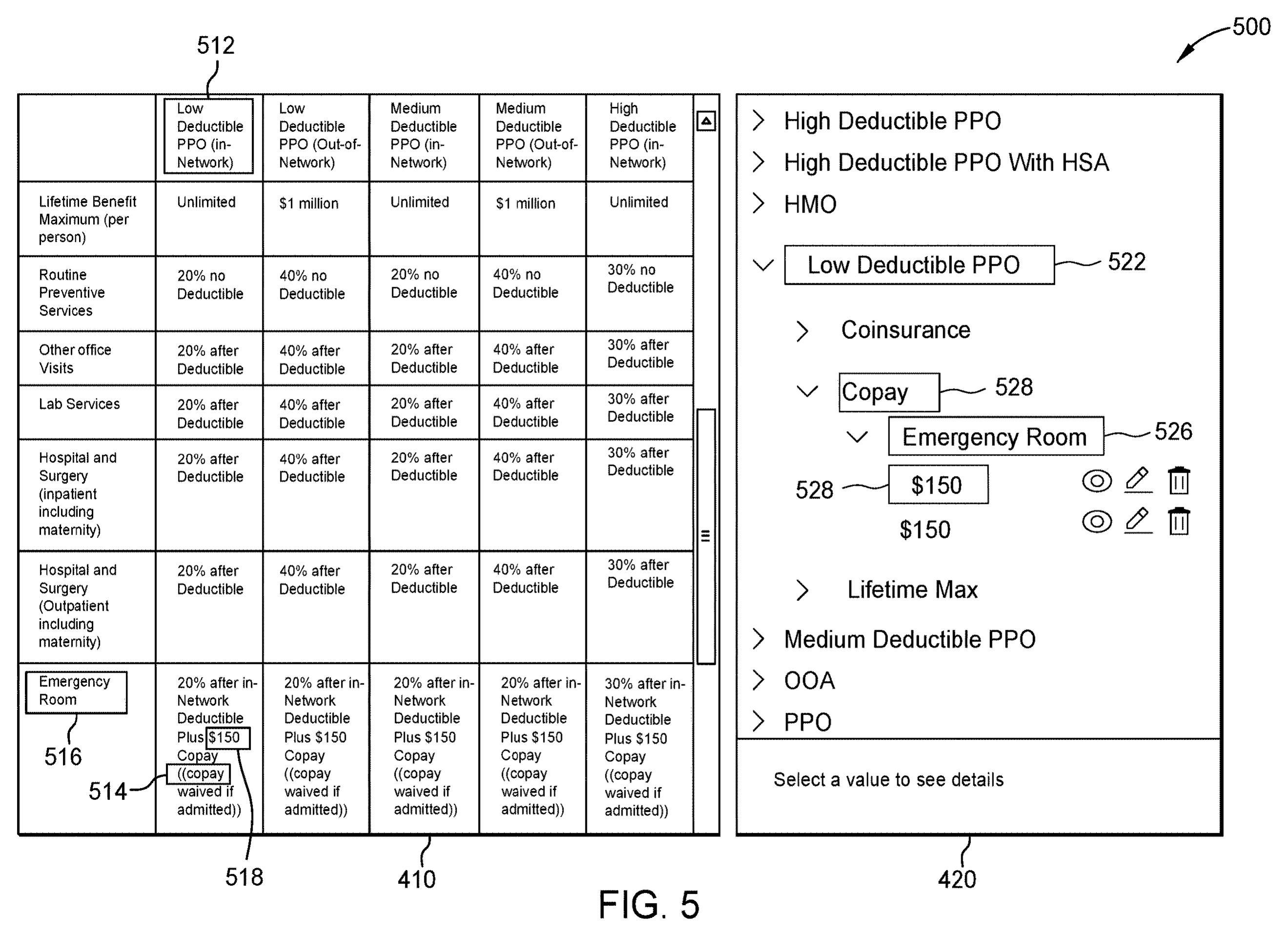
Several other IBM patents Anthropic bought tackle neighboring problems in post-training and enterprise deployment. One recurring challenge in post-training tool-using models is that you cannot easily pass mathematical training signals through a live outside calculator, database, or third-party API; U.S. 11,625,609 works around that by training the neural network alongside a neural "stand-in" that mimics the external software during training, then plugging the real software back in at runtime (complemented by two 2015 IBM grants, U.S. 9,015,730 and U.S. 9,092,276, on mapping plain-English requests into API calls). Two pairs of grants echo the S-1’s emphasis on prompt injection and red-teaming: one pair (U.S. 11,520,829 and U.S. 11,755,657) trains question-answering models on pairs of clean passages and deliberately doctored, misleading passages so the model learns not to fall for bad context, while another pair (U.S. 11,501,156 and U.S. 11,829,879) uses decoy training to catch adversarial inputs. And U.S. 11,676,011 (Private transfer learning) addresses enterprise customization: it encrypts a pretrained model with credentials programmed directly inside the model that dictate who is allowed to fine-tune it and how, then runs any customer fine-tuning inside a hardware-locked secure enclave so neither the lab’s weights nor the customer’s data leak (paired with U.S. 11,010,637 on training across local devices without centralizing private data).
Other IBM grants target the sheer cost of training and serving models at scale. U.S. 11,763,082 compresses a transformer for a specific language task by finding and cutting redundant intermediate math in earlier transformer blocks, then feeding replacement signals into later blocks so accuracy holds up with less compute. U.S. 10,949,746 coordinates a CPU with multiple GPUs to overlap gradient transfers with layer-by-layer backpropagation, while four speech grants—including U.S. 11,783,811 and U.S. 12,288,551—use an offline bidirectional teacher model to train a fast, real-time unidirectional speech recognizer and reconstruct unfamiliar vocabulary.
Finally, three IBM grants from the May 2025 deal sit right in the wheelhouse of legal and financial document review. U.S. 11,423,042 pulls structured records out of unstructured documents while tying each extracted fact to its exact spot in the original text—independent claims IBM won without changing a word over older form-reading software, even though China’s patent office, searching the companion international filing WO2021156684A1, flagged an Alibaba resume-parsing filing that never appeared on the U.S. examiner’s considered lists. Its companion patent, U.S. 11,392,753, covers a two-pane viewer where clicking an extracted item in a tree jumps straight to that clause in the source document, while U.S. 11,037,049 works backward from an AI answer to estimate each source’s influence. As with Computer Use, the product dates keep any speculation grounded: Anthropic shipped API Citations in January 2025, four months before buying the IBM patents, and neither its October 2026 legal contract-review release nor the Legora legal-AI case study filed with the S-1 ties Claude to IBM’s specific claim language.
The Missing Half of the Portfolio: Anthropic’s International Patents
Nearly every outside look at Anthropic’s IP stops at the U.S. border—yet page 246 of the S-1/A reports 26 issued foreign patents and 12 pending foreign applications as of September 30, 2026 (up from 22 foreign grants at year-end 2025).
Standard English-language name searches miss most of that overseas portfolio because foreign registries lag behind private deals, translate company names into local scripts, or leave party names out of summary event feeds. Instead of relying on company-name searches alone, we traced every overseas family member descending from the IBM and Adept deals across national patent offices. That search uncovered 39 national filings across seven countries—25 published grants, 12 pending published applications, and 2 withdrawn British applications—plus 8 international Patent Cooperation Treaty (PCT) filings, which hold an applicant’s place in line internationally without granting a patent on their own. Ten of the 17 families in IBM’s May 2025 sale carried foreign national filings; IBM’s September 2026 batch of 12 U.S. patents had none, and Adept’s April 2025 sale contributed one international filing—PCT/US2025/020719 (WO2025199330A1), on turning screen recordings into agent training data—where WIPO recorded the transfer to Anthropic on May 12, 2025.
| Jurisdiction | Issued Grants | Pending Cases | Dead | Registry Ownership & Diligence Findings |
|---|---|---|---|---|
| China (CNIPA) | 7 | 5 | 0 | Register entry10 IBM-origin cases show Aug. 2025 transfer events; 2 post-transfer divisionals (CN120808758A, CN122615052A) name Anthropic in Chinese (安瑟波尼公共福利公司, machine-indexed as "Anselponi Public Benefit Corp." or "Ansebony Public Welfare Company"). |
| Japan (JPO) | 7 | 2 | 0 | Register entryTwo 2026 grants (JP7807441B2, JP7862364B2) and two 2026 divisionals print Anthropic in katakana (アンソロピック,ピービーシー); five 2024 grants still display IBM on publication faces. |
| Germany (DPMA) | 3 | 2 | 0 | Register entryDirect register confirmation: All 5 official DPMA register files explicitly name Anthropic, PBC as current owner/applicant and IBM as predecessor (recorded Aug.–Dec. 2025). |
| United Kingdom (UKIPO) | 3 | 2 | 2 | Register entryAll 3 grants (GB2604804B, GB2602227B, GB2602575B) carry Nov.–Dec. 2025 Section 32 register-change notices omitting transferee names; 2 earlier filings closed pre-sale (2023, 2024). |
| Australia (IP Australia) | 2 | 0 | 0 | Register entryDirect register confirmation: Official dockets and Oct. 2025 patentee renewal notices name Anthropic, PBC on both AU2020369228B2 and AU2020385049B2 (assigned July 2025). |
| Singapore (IPOS) | 2 | 0 | 0 | Register entryDirect register confirmation: IPOS records IBM transferring 11202203493W and 11202204720U on Sept. 16, 2025 (entries logged Sept. 22). 11202204720U briefly lapsed past its Nov. 10, 2026 deadline before its 7th-year late renewal was logged Nov. 18, returning it to in-force status. |
| South Korea (KIPO) | 1 | 1 | 0 | Register entryJan. 2026 grant KR102914804B1 and Feb. 2026 divisional KR20260016013A name Anthropic in Korean (엔트로픽, 피비씨) following a July 2025 applicant change. |
| Total National Cases | 25 | 12 | 2 | 39 national cases traced (+ 8 separate PCT publications); at least 1 of Anthropic’s 26 S-1 foreign grants remains unidentified. |
Digging into those foreign files turns up gaps that summary IPO numbers hide. Even if Anthropic owns all 25 foreign grants we traced in the IBM families, at least one of the 26 foreign patents Anthropic reported on page 246 remains unidentifiable from public family trees or ownership indexes (just as its year-end 2025 count of 22 exceeded our 21 traced grants by one). At the same time, outside trackers have missed documented transfers: patent consultancy Lumenci’s October 2025 portfolio report, which used a September 23, 2025 cutoff, left out Singapore altogether—even though Singapore’s registry shows IBM transferred two granted patents there (covering private transfer learning and "learning to teach" training weights) on September 16, 2025 and logged the entries on September 22. Keeping up with foreign renewals matters too: the Singapore training-weights grant (11202204720U) briefly entered lapsed status after passing its November 10, 2026 deadline before a seventh-year late renewal was logged on November 18, returning the patent to in-force status.
More importantly, patents sharing the exact same English title often cover completely different things from one country to the next. Take IBM’s Private transfer learning family, which spans six countries across the acquired IBM portfolio (the U.S., Australia, China, Britain, Japan, and Singapore). In the United States (11,676,011), Australia (AU2020369228B2), and Singapore, Claim 1 covers fine-tuning a general deep neural network inside a secure enclave using credentials built into the model (while China’s CN114586030B adds controls over how much the model’s interfaces may be used). Open Anthropic’s British grant in the same family (GB2604804B), however, and Claim 1 requires the system to analyze hyperspectral satellite imagery—meaning a competitor training text or contract models in Britain does not touch that patent at all.
Elsewhere, the foreign claims shift coverage in both directions—sometimes broader at the training stage, sometimes narrower. In the misleading-passage Q&A family, Anthropic’s U.S. grant (11,755,657) only applies when a system both trains on clean and doctored passages and goes on to answer a later question; in China, Anthropic’s August 2026 divisional filing (CN122615052A) seeks main claims that stop at the training step, aiming directly at the training pipeline itself. Conversely, Chinese writing-style patent (CN111797597B) bakes specific subject areas—including legal, medical, academic, and advertising writing—straight into a narrower Claim 1 rather than dependent claims, whereas Chinese and Japanese sequence-training grants (CN114450746B; JP7537708B2) cover general "information blocks" where their U.S., German, and British counterparts are restricted to acoustic sequences. Even automated translations can trip up diligence: Google Patents’ English machine translation of Anthropic’s May 2026 Japanese speech patent (JP7862364B2) wrongly describes all three encoders in its main claims as two-way, whereas the Japanese original specifies one-way, two-way, then one-way—matching U.S. 11,783,811.
Collateral, Missing Contracts, and Pre-IPO Lawsuits
Why did an AI lab that keeps its core frontier training recipes as trade secrets buy 40 U.S. patents and roughly two dozen foreign grants in the run-up to going public? Across the SEC filings, lender records, and federal court dockets, those acquired patents show up in Anthropic’s IPO story as loan collateral and defensive leverage—while leaving prospective shareholders in the dark on what Anthropic paid and what strings IBM kept attached.
Start with Anthropic’s lenders. On September 4, 2026—the same day IBM signed its second 12-patent sale—a USPTO collateral filing pledged 50 intellectual-property entries to Morgan Stanley Senior Funding as agent for Anthropic’s banks. All 34 IBM-origin U.S. patents (including newly issued 12,682,280) sit on that schedule, alongside seven pending Adept-family applications and nine older provisional filings (leaving the six issued Adept grants off the itemized schedule, though Anthropic’s 2025 security agreement covers later-acquired U.S. patents subject to exceptions). Read alongside page 171 of the S-1/A, those patents sit inside the collateral backing Anthropic’s $15 billion revolving credit line, which had zero borrowings drawn and $205 million in standby letters of credit as of September 30, with no separate dollar value assigned to the patents.
At the same time, going public makes Anthropic a bigger target for patent plaintiffs, a point the company’s own filings quietly acknowledge. Between its June 1 confidential draft S-1 and its July 13 amendment, Anthropic softened its description of its patent effort—dropping a claim that its program was meant to "identify and protect a substantial portion of our strategic intellectual property" in favor of "covering certain technologies relevant to our business." Meanwhile, Anthropic’s Risk Factors warn that rivals with larger patent stockpiles hold an edge in licensing disputes and counter-claims. Two Delaware lawsuits already illustrate the incoming fire. In July 2026, the University of Tennessee Research Foundation sued Anthropic over two neural-circuit patents, stretching a claim requirement about predicting component failure in an automated device to accuse Claude Code’s background memory-consolidation routines when a session nears its context or memory limit (Anthropic moved to dismiss in October). Then on November 12—just two days after Anthropic’s November 10 S-1 amendment, and citing the IPO filing on page 2—Flinn AI Technologies sued over five iterative-attention neural-network patents, filing 270 pages of claim charts that accuse document retrieval in Claude Projects of infringing multi-attention embedding claims like Claim 1 of U.S. 12,511,580. Both suits remain unproven allegations, and owning operating patents will not deter non-practicing entities—though a 40-patent war chest across agents, post-training, and inference gives Anthropic real bargaining chips if an operating competitor ever sues.
What the S-1 still leaves out is just as striking as what it discloses. Unlike the $171 million Bun purchase and the $306 million Stainless purchase, Anthropic never breaks out what it paid IBM or Adept, burying any 2025 patent spend inside company-wide cash-flow lines ($29 million for all intangible-asset purchases in the June draft; $23 million in net other investing cash outflows in the November 17 filing), while leaving any September 2026 patent spend unitemized inside $248 million of nine-month 2026 other investing outflows. Nor does Anthropic file Agreement No. L241226—the separate side contract cited in IBM’s May 2025 deed preserving pre-existing third-party licenses and carving out retained rights for IBM. Although IBM and Anthropic partnered on enterprise software in October 2025 and co-founded the Shared AI License (SAIL) Foundation in April 2026 (which cross-licenses foundation-model patents royalty-free while carving out end-user applications), L241226 does not appear in Anthropic’s IPO exhibit index, the deed for IBM’s second 12-patent transfer cannot be downloaded publicly, and IBM still holds sibling patents by the very same inventors (including table-processing patent U.S. 12,784,486, issued to IBM on November 3, 2026). Even Anthropic’s 67 pending U.S. applications—35 unpublished provisionals and 32 nonprovisionals listed without serial numbers—include at least 10 public filings inherited or continued from Adept and IBM.
Page 246 of the prospectus gives IPO investors tidy totals. What it does not tell them is what Anthropic paid IBM and Adept to buy 100% of its issued U.S. patent portfolio, who already holds licenses to those patents under L241226, or whether a single issued patent in Anthropic’s registration statement started inside Anthropic’s own walls.
Appendix A: All 40 Issued U.S. Patents Held by Anthropic (as of Sept. 30, 2026)
Reconstructed from USPTO Assignment Center deeds, prosecution dockets, and official grants matching the September 30, 2026 S-1/A cutoff. Every patent number links directly to the official USPTO grant PDF.
| U.S. Patent | Origin | Status When Bought | Grant Date | On $15B Loan Schedule | Title |
|---|---|---|---|---|---|
| 9,015,730 | IBM (Sept. ’26) | Issued | Apr 21, 2015 | Yes | Natural Language Access to Application Programming Interfaces |
| 9,092,276 | IBM (Sept. ’26) | Issued | Jul 28, 2015 | Yes | Natural Language Access to Application Programming Interfaces |
| 10,579,940 | IBM (Sept. ’26) | Issued | Mar 3, 2020 | Yes | Joint embedding of corpus pairs for domain mapping |
| 10,679,000 | IBM (Sept. ’26) | Issued | Jun 9, 2020 | Yes | Interpreting conversational authoring of information models |
| 10,949,746 | IBM (May ’25) | Issued | Mar 16, 2021 | Yes | Efficient parallel training of a network model on multiple graphics processing units |
| 10,977,439 | IBM (May ’25) | Issued | Apr 13, 2021 | Yes | Controllable Style-Based Text Transformation |
| 11,010,637 | IBM (May ’25) | Issued | May 18, 2021 | Yes | Generative adversarial network employed for decentralized and confidential AI training |
| 11,037,049 | IBM (May ’25) | Issued | Jun 15, 2021 | Yes | Determining rationale of cognitive system output |
| 11,158,303 | IBM (May ’25) | Issued | Oct 26, 2021 | Yes | Soft-forgetting for connectionist temporal classification based automatic speech recognition |
| 11,183,194 | IBM (May ’25) | Issued | Nov 23, 2021 | Yes | Detecting and recovering out-of-vocabulary words in voice-to-text transcription systems |
| 11,361,571 | IBM (May ’25) | Issued | Jun 14, 2022 | Yes | Term extraction in highly technical domains |
| 11,392,753 | IBM (May ’25) | Issued | Jul 19, 2022 | Yes | Navigating unstructured documents using structured documents including information extracted from unstructured documents |
| 11,423,042 | IBM (May ’25) | Issued | Aug 23, 2022 | Yes | Extracting information from unstructured documents using natural language processing and conversion of unstructured documents into structured documents |
| 11,436,487 | IBM (Sept. ’26) | Issued | Sep 6, 2022 | Yes | Joint embedding of corpus pairs for domain mapping |
| 11,443,235 | IBM (May ’25) | Issued | Sep 13, 2022 | Yes | Identifying optimal weights to improve prediction accuracy in machine learning techniques |
| 11,487,827 | IBM (Sept. ’26) | Issued | Nov 1, 2022 | Yes | Extended query performance prediction framework utilizing passage-level information |
| 11,501,156 | IBM (May ’25) | Issued | Nov 15, 2022 | Yes | Detecting Adversarial Attacks through Decoy Training |
| 11,520,829 | IBM (May ’25) | Issued | Dec 6, 2022 | Yes | Training a question-answer dialog sytem to avoid adversarial attacks |
| 11,580,416 | IBM (Sept. ’26) | Issued | Feb 14, 2023 | Yes | Improving the accuracy of a compendium of natural language responses |
| 11,586,849 | IBM (May ’25) | Issued | Feb 21, 2023 | Yes | Mitigating statistical bias in artificial intelligence models |
| 11,625,609 | IBM (May ’25) | Issued | Apr 11, 2023 | Yes | Integration of external applications into deep neural networks |
| 11,676,011 | IBM (May ’25) | Issued | Jun 13, 2023 | Yes | Private transfer learning |
| 11,687,385 | IBM (Sept. ’26) | Issued | Jun 27, 2023 | Yes | Unsupervised event extraction |
| 11,734,509 | IBM (May ’25) | Issued | Aug 22, 2023 | Yes | Controllable Style-Based Text Transformation |
| 11,755,657 | IBM (May ’25) | Issued | Sep 12, 2023 | Yes | Training a Question-Answer Dialog System to Avoid Adversarial Attacks |
| 11,763,082 | IBM (May ’25) | Issued | Sep 19, 2023 | Yes | Accelerating inference of transformer-based models |
| 11,783,811 | IBM (May ’25) | Issued | Oct 10, 2023 | Yes | Accuracy of streaming RNN transducer |
| 11,790,015 | IBM (Sept. ’26) | Issued | Oct 17, 2023 | Yes | Extended query performance prediction framework utilizing passage-level information |
| 11,829,879 | IBM (May ’25) | Issued | Nov 28, 2023 | Yes | Detecting Adversarial Attacks through Decoy Training |
| 11,901,047 | IBM (Sept. ’26) | Issued | Feb 13, 2024 | Yes | Medical visual question answering |
| 11,989,237 | IBM (Sept. ’26) | Issued | May 21, 2024 | Yes | Natural language interaction with automated machine learning systems |
| 12,001,896 | IBM (Sept. ’26) | Issued | Jun 4, 2024 | Yes | Unsupervised event extraction |
| 12,288,551 | IBM (May ’25) | Issued | Apr 29, 2025 | Yes | Accuracy of streaming RNN transducer |
| 12,682,280 | IBM (May ’25) | Pending (PTAB Appeal) | Jul 14, 2026 | Yes | Identifying optimal weights to improve prediction accuracy in machine learning techniques |
| 12,387,036 | Adept (Apr. ’25) | Pending (Allowed Jan. ’25) | Aug 12, 2025 | Not itemized | Multimodal Agent for Efficient Image-Text Interface Automation |
| 12,430,150 | Adept (Apr. ’25) | Pending (Allowed Feb. ’25) | Sep 30, 2025 | Not itemized | Runtime Architecture for Interfacing with Agents to Automate Multimodal Interface Workflows |
| 12,437,238 | Adept (Apr. ’25) | Pending (Allowed Mar. ’25) | Oct 7, 2025 | Not itemized | Generation of Agentic Trajectories for Training Artificial Intelligence Agents to Automate Multimodal Interface Task Workflows |
| 12,566,913 | Adept (Apr. ’25) | Pending (Amended by Anthropic) | Mar 3, 2026 | Not itemized | Artificial Intelligence Agents to Automate Multimodal Interface Task Workflows |
| 12,585,862 | Adept (Apr. ’25) | Pending | Mar 24, 2026 | Not itemized | Training Data for Training Artificial Intelligence Agents to Automate Multimodal Software Usage |
| 12,619,815 | Adept (Apr. ’25) | Pending | May 5, 2026 | Not itemized | Magnitude Invariant Multimodal Agent for Efficient Image-Text Interface Automation |
Appendix B: Complete Index of Traced Foreign Grants, Pending National Cases & PCT Filings
Every traced overseas national member (25 grants, 12 pending applications, 2 closed UK filings across 7 countries) and 8 international PCT publications descending from Anthropic’s acquired IBM and Adept families, linked to English claim texts or official national register filings:
Private transfer learning (US 11,676,011 family): AU2020369228B2 (Australia grant) · CN114586030B (China grant) · GB2604804B (UK grant, hyperspectral satellite claims) · JP7572132B2 (Japan grant) · SG 11202203493W (Singapore grant) · WO2021079299A1 (PCT)
Adaptive RL sample weighting / "learning to teach" (US 11,443,235 / 12,682,280 family): AU2020385049B2 (Australia grant) · JP7471408B2 (Japan grant) · KR102914804B1 (South Korea Jan. 2026 grant) · SG 11202204720U (Singapore grant; 7th-year late renewal logged Nov. 18, 2026) · CN114616577A (China pending) · DE112020005610T5 (Germany pending) · KR20260016013A (South Korea Feb. 2026 pending divisional) · GB2603445A (UK withdrawn 2023) · WO2021094923A1 (PCT)
Training Q&A models against misleading/adversarial passages (US 11,520,829 / 11,755,657 family): CN116324804B (China May 2026 grant) · JP7807441B2 (Japan Jan. 2026 grant) · CN122615052A (China Aug. 2026 pending divisional, training-stage independent claims) · DE112021004694T5 (Germany pending) · JP2026074008A (Japan May 2026 pending divisional) · GB2615666A (UK withdrawn 2024) · WO2022083291A1 (PCT)
Streaming RNN-T speech distillation (US 11,783,811 / 12,288,551 family): DE112021004199B4 (Germany grant) · JP7862364B2 (Japan May 2026 grant, original Japanese 1-way / 2-way / 1-way claims) · CN116250037A (China pending) · GB2614674A (UK pending) · JP2026095462A (Japan June 2026 pending divisional) · WO2022063614A1 (PCT)
Soft-forgetting CTC speech training (US 11,158,303 family): CN114450746B (China grant) · DE112020003449B4 (Germany grant) · GB2602227B (UK grant) · JP7537708B2 (Japan grant) · WO2021038364A1 (PCT)
Out-of-vocabulary speech recovery (US 11,183,194 family): CN114402386B (China grant) · DE112020004348B4 (Germany grant) · GB2602575B (UK grant) · JP7593721B2 (Japan grant) · CN120808758A (China pending divisional) · WO2021048781A1 (PCT)
Structured NLP document extraction (US 11,423,042 family): JP7593725B2 (Japan grant) · CN114945911A (China pending) · GB2607833A (UK pending) · WO2021156684A1 (PCT, with Chinese ISR on p. 31)
Single-country Chinese grants (3 IBM families): CN110610234B (external software integration, US 11,625,609) · CN110659485B (decoy adversarial detection, US 11,501,156 / 11,829,879) · CN111797597B (controllable writing-style transformation including legal domain in Claim 1, US 10,977,439 / 11,734,509)
Adept GUI-agent trajectory generation (US 12,437,238 family): WO2025199330A1 (PCT/US2025/020719, WIPO transfer to Anthropic recorded May 12, 2025; KIPO search selection)